Thursday, October 1, 2020

Hebrew Origins & Original Learning: Intro- Attention Activity

 Here is a lesson plan I wrote out for those interested in really delving into original patterns of learning and the origins of ancient Hebrew

----------

Begin by singing: “For the Beauty of the Earth” (hymn # 92) or “How Great Thou Art” (hymn #86)


Ponder: Look at a picture of "Adam and Even the Garden"

Why did God place Adam and Eve in a garden? What learning opportunities were available to them in nature? Could nature teach them symbolically?


Experience: Take your family for a walk out in nature--what do you notice? 

Use your senses: ears, eyes, nose, taste, feel.

Now feel with your heart. Open your mind and heart to revelation. Let your curious nature guide you to ask questions and explore more. What else can God be trying to teach you? Do you see patterns in nature that remind you of God’s nature and His principles?


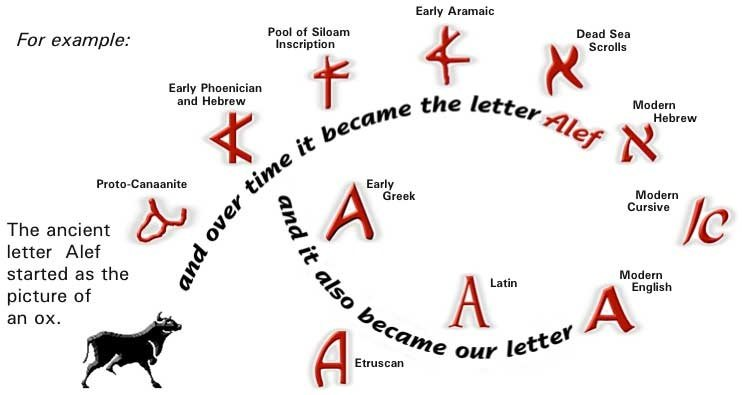
Go Deeper: How could learning from nature connect with everyday learning--say the development of an alphabet? Is it possible that each letter of the alphabet could even have something to teach us? Let’s explore that thought...take a look at this photo:

What do you notice?
Where did the letter "A" come from?
Can you see how time literally turned it around?


Optional Further Exploration:
You can watch this video to get a better perspective into origins of Hebrew language as the original source of the English language, or use the resources section ideas/links.
"The Hebrew Origin of the English Alphabet" by Jeff Benner, www.ancient-hebrew.org


Continue learning more with part 2 of this lesson


Saturday, August 1, 2020

Why Learn Hebrew? Thus saith Luther & Joseph

Why Hebrew?

Martin Luther’s Thoughts...


“The Hebrew language is the best language of all, with the richest vocabulary . . . . If I were younger I would want to learn this language, because no one can really understand the Scriptures without it. For although the New Testament is written in Greek, it is full of hebraisms and Hebrew expressions. It has therefore been aptly said that the Hebrews drink from the spring, the Greeks from the stream that flows from it, and the Latins from a downstream pool.” (Martin Luther, Tischreden)


The Reformation reminds us why. “Ad fontes!”—To the fountains, or sources!—was their battle cry for a reason. 


“The languages are the sheath in which this sword of the Spirit is contained; they are the casket in which this jewel is enshrined; they are the vessel in which this wine is held; they are the larder in which this food is stored; and, as the gospel itself points out, they are the baskets in which are kept these loaves and fishes and fragments. If through our neglect we let the languages go (which God forbid!), we shall…lose the gospel...” (Martin Luther, emphasis added, 120)


So here are Five Reasons...

1) History Reminds Us

“Experience too has proved this and still gives evidence of it. For as soon as the languages declined to the vanishing point, after the apostolic age, the gospel and faith and Christianity itself declined more and more…On the other hand, now that the languages have been revived, they are bringing with them so bright a light and accomplishing such great things that the whole world stands amazed and has to acknowledge that we have the gospel...far beyond what it was in the days of St. Jerome and St. Augustine… “(120)


2) The Fathers Remind us

“Yes, you say, but many of the fathers were saved and even became teachers without the languages. That is true. But how do you account for the fact that they so often erred in the Scriptures?…Even St. Augustine himself is obliged to confess…that a Christian teacher who is to expound the Scriptures must know Greek and Hebrew in addition to Latin. Otherwise, it is impossible to avoid constant stumbling; indeed, there are plenty of problems to work out even when one is well versed in the languages”. (120)


3) Vocational Excellence Reminds Us 

There is a vast difference therefore between a simple preacher of the faith and a person who expounds Scripture, or, as St. Paul puts it, a prophet. A simple preacher (it is true) has so many clear passages and texts available through translations that he can know and teach Christ, lead a holy life, and preach to others. But when it comes to interpreting Scripture, and working with it on your own, and disputing with those who cite it incorrectly, he is unequal to the task; that cannot be done without languages. Now there must always be such prophets in the Christian church who can dig into Scripture, expound it, and carry on disputations. A saintly life and right doctrine are not enough. Hence languages are absolutely and altogether necessary in the Christian church, as are the prophets or interpreters; although it is not necessary that every Christian or every preacher be such a prophet, as St. Paul points out in I Corinthians 12 and Ephesians 4”… (120-121)


4) Common Grace Reminds us...

“Since it becomes Christians then to make good use of the Holy Scriptures as their one and only book and it is a sin and a shame not to know our own book or to understand the speech and words of our God, it is a still greater sin and loss that we do not study languages, especially in these days when God is offering and giving us men and books and every facility and inducement to this study, and desires his Bible to be an open book. O how happy the dear fathers would have been if they had had our opportunity to study the languages and come thus prepared to the Holy Scriptures! What great toil and effort it cost them to gather up a few crumbs, while we with half the labor—yes, almost without any labor at all—can acquire the whole loaf! O how their effort puts our indolence to shame! Yes, how sternly God will judge our lethargy and ingratitude!” (121)


Are we grateful for the Masoretic Text; for Codex Vadicanus, Codex Alexandrinus, and Codex Sinaiticus; for the Dead Sea Scrolls?


5) Preaching Reminds is...

“Here belongs also what St. Paul calls for in I Corinthians 14, namely, that in the Christian church all teachings must be judged. For this a knowledge of the language is needful above all else. The preacher or teacher can expound the Bible from beginning to end as he pleases, accurately or inaccurately, if there is no one there to judge whether he is doing it right or wrong. But in order to judge, one must have a knowledge of the languages; it cannot be done in any other way. Therefore, although faith and the gospel may indeed be proclaimed by simple preachers without a knowledge of languages, such preaching is flat and tame; people finally become weary and bored with it, and it falls to the ground. But where the preacher is versed in the languages, there is a freshness and vigor in his preaching, Scripture is treated in its entirety, and faith finds itself constantly renewed by a continual variety of words and illustrations. Hence, Psalm 129 likens such scriptural studies to a hunt, saying to the deer God opens the dense forests; and Psalm 1 likens them to a tree with a plentiful supply of water, whose leaves are always green” (121)


—-

Joseph Smith’s Thoughts...

“reading in our hebrew bibles . . . it seems as if the Lord opens our minds, in a marvelous manner to understand his word in the original language, and my prayer is that God will speedily indue us with a knowledge of all languages and toungs, that his servants may go forth for this last time, to bind up the law and seal up the testimony.”


“the use of the Hebrew school stated that the study of Hebrew would “serve to facilitate the acquisition of a perfect knowledge of one of the best of books—the Scriptures—the introduction of which has served to dispel darkness, and disperse light into every clime.”


“seek out of the best books,” 

“become acquainted . . . with languages, tongues, and people,” and “obtain a knowledge of history.” This new emphasis on academic learning was meant to prepare the lay ministers of the Church “to magnify their calling,” “receive revelations to unfold the mysteries of the kingdom,” and “set in order all the affairs of this church.” “All this,” the revelations stated, would be “for the salvation of Zion.”


Joseph declared: “I am determined to persue the study of languages untill I shall become master of them, if I am permitted to live long enough, at any rate so long as I do live I am determined to make this my object, and with the blessing of God I shall succe[e]d to my sattisfaction.”


Joseph also went beyond his contemporaries by drawing out deeper (and he felt more pristine) meanings from Hebrew phraseology 

Friday, February 28, 2020

Book Notes: Tramp for the Lord-Corrie TenBoom

100- Tramp for the Lord
Corrie Ten Boome

The life of a Christian is an education for higher service.

Faith is like radar which sees through the fog--the reality of things at a distance that the human eye cannot see.

My life is but a weaving, between my God and me,
I do not count the colors, he worketh steadily
Oftimes he weaveth sorrow and I in foolish pride forget He sees the upper and i the underside.
Not took the look is silent and shuttles cease to fly will God until the canvas and explain the reason why.
The dark threads are as needful in the skillful Weavers hand, as the threads of God and silver in the pattern he had planned.

(Purpose of book: "pray the Holy Spirit will reveal something of the divine pattern in God's plan for you also.")

Singing was one of the ways we kept up our courage.

When you come near death God's presence is even more real. It is here that Jesus comes closest taking our hand and leading us through.

For more than a year I had not been allowed to make a decision. All I could do was follow orders. It was difficult even to think.

I was starved for color.

Only to those who have been in prison does freedom have such great meaning.
I knew my life had been given back for a purpose. I was no longer my own.
The material things of this world no longer excited me --nor would they ever again.

We grew up knowing only a God who enjoyed our presence as we skipped and ran and played through his church built for his glory.

I soon discovered that man's importunity is God's opportunity. He uses our problems as building materials for his miracles. This was the first step in my path towards trusting him.

(As waited in line for approval of papers) "lord I am willing To go or stay. It is up to you."
It is not our task to give God instructions. We are simply to report for duty .

"Corrie, there is so much bitterness. We must tell them that the holy spirit will fill their hearts with love." -betsie (sister)
Only God could see in such circumstances the possibility for ministry in the future. (On going back to Germany to help)

Gods guidance is even more important than common sense.

Psalms 47:11
The lord taketh pleasure...in those that hope in his mercy.

"God does not fill with the holy spirit those who believe in the files of the spirit, or those who desire him, but those who obey him." -FB Meyer

...sometimes it helps just to have someone willing to listen

That which is in your heart can never be taken from you.

The only way to get rid of [bitterness] is to surrender it. If we forgive others then our hearts are made fit to receive forgiveness.
(God can use even a leeks man if he is surrendered.)
Love even when you don't want to. The secret of victory is obedience. Obedience is easy when you know you are being guided by a God who never makes mistakes. Obedience never says "yes, but..." Rather it always says "yes, Lord!"

Throw your sins into the deep sea. "No fishing allowed."

Forgiveness is not an emotion. It is an act of will, and the will can function regardless of the temperature of the Heart. ("Jesus help. I can supply the hand. You supply the feeling.")

For ten years after my release from prison I had been traveling all over the world at the direction of God. Many times I did not know why I was to go to a certain place until I arrived. it had become almost second nature not to make my plans and then ask for God's signature.rather, I had learned to wait for goods plan and then write my name on the schedule.

When one is abiding under the shadow of the almighty there will be no light, but that is only because God’s presence is so near. ("I eagerly await whatever you have planned for me.")

After this experience (repenting and having hip healed) I was filled with the holy spirit. Now, going in the power of the holy spirit to Germany God was able to work much deliverance through me as we commanded demons to be cast out in his name.

Trying to do the Lord's work in your own strength is the most confusing and exhausting and tedious of all work. But when you are filled with the holy spirit. Then the ministry of Jesus flows out of you.
Now, whether I am walking in the bright light of his presence or abiding under the shadow of the almighty, I know that he is not only with me, he is in me.

We worked as a team (not to say that we didn't have difficulties --as always happens when people work close together). However, those hard moments were used to bring us closer to Jesus as we learned to walk in the light with each other.

Recognize that we are surrounded not only by angels but also by the powers of darkness. Our fight is not against a physical any, political party, an atheistic organization --or anything like that. Or fight is against organizations and powers that are spiritual. Therefore we must wear the whole armor of God.

Betsie: "let us dedicate this involuntary fast to the lord that it may become a blessing."

I would much rather be the child of a trusting father, than a beggar at the door of worldly men.

I knew I was not right with God for I was not right with man.

Life is like an embroidery. It seems knotted and tangled, but we are looking at the back side. Good has a beautiful crown waiting for us on the other side. And he can show us glimpses...

The Bible is like chocolate, not to be analyzed and picked apart...but to be eaten /enjoyed.

"Daddy, I am afraid that I will never have strength to be a martyr."
"Today you don't need the strength to be a martyr ; but as soon as you are called for the honor of facing death for Jesus, he will supply the strength you need --just in time."

I had learned that it was not me but the word of God coming through me that won people to Christ.

You are not called to convince anyone. You are simply called to be an open channel for the spirit of God to flow through. Follow the path of obedience, let the word of God do is own work, and you will be used by God far beyond your own powers.

It is the word of God that is their foundation and therefore it is essential for the convert of Christ to have a practical knowledge of the Bible.

Happiness is not dependent on the happenings but rather on the relationships in the happenings.

Theology in the hands of the holy spirit is a beautiful science. But in the hands of unbelievers it is death. If you want to find where heaven is, get out of your study classroom and go back out into the countryside.

The incident made me upset because I hadn't surrendered my self-righteousness. Self pity is a nasty sin and the devil uses it...and it always starts with "poor me...."

Tuesday, April 4, 2017

Charlotte Mason Principles

Summary/Rewording of Charlotte Mason's 20 Principles
1. Children are born persons.
1. Children are born persons - they are not blank slates or embryonic oysters who have the potential of becoming persons. They already arepersons.
2. They are not born either good or bad, but with possibilities for good and for evil. *see note
2. Although children are born with a sin nature, they are neither all bad, nor all good. Children from all walks of life and backgrounds may make choices for good or evil.
3. The principles of authority on the one hand, and of obedience on the other, are natural, necessary and fundamental; but--
3. The concepts of authority and obedience are true for all people whether they accept it or not. Submission to authority is necessary for any society or group or family to run smoothly.
4. These principles are limited by the respect due to the personality of children, which must not be encroached upon whether by the direct use of fear or love, suggestion or influence, or by undue play upon any one natural desire.
4. Authority is not a license to abuse children, or to play upon their emotions or other desires, and adults are not free to limit a child's education or use fear, love, power of suggestion, or their own influence over a child to make a child learn.
5. Therefore, we are limited to three educational instruments--the atmosphere of environment, the discipline of habit, and the presentation of living ideas. The P.N.E.U. Motto is: "Education is an atmosphere, a discipline, and a life."
5. The only means a teacher may use to educate children are the child's natural environment, the training of good habits and exposure to living ideas and concepts. This is what CM's motto "Education is an atmosphere, a discipline, a life" means.
6. When we say that "education is an atmosphere," we do not mean that a child should be isolated in what may be called a 'child-environment' especially adapted and prepared, but that we should take into account the educational value of his natural home atmosphere, both as regards persons and things, and should let him live freely among his proper conditions. It stultifies a child to bring down his world to the child's level.
6. "Education is an atmosphere" doesn't mean that we should create an artificial environment for children, but that we use the opportunities in the environment he already lives in to educate him. Children learn from real things in the real world
7. By "education is a discipline," we mean the discipline of habits, formed definitely and thoughtfully, whether habits of mind or body. Physiologists tell us of the adaptation of brain structures to habitual lines of thought, i.e., to our habits.
7. "Education is a discipline" means that we train a child to have good habits and self-control.
8. In saying that "education is a life," the need of intellectual and moral as well as of physical sustenance is implied. The mind feeds on ideas, and therefore children should have a generous curriculum.
8. "Education is a life" means that education should apply to body, soul and spirit. The mind needs ideas of all kinds, so the child's curriculum should be varied and generous with many subjects included.
9. We hold that the child's mind is no mere sac to hold ideas; but is rather, if the figure may be allowed, a spiritual organism, with an appetite for all knowledge. This is its proper diet, with which it is prepared to deal; and which it can digest and assimilate as the body does foodstuffs.
9. The child's mind is not a blank slate, or a bucket to be filled. It is a living thing and needs knowledge to grow. As the stomach was designed to digest food, the mind is designed to digest knowledge and needs no special training or exercises to make it ready to learn.
10. Such a doctrine as e.g. the Herbartian, that the mind is a receptacle, lays the stress of education (the preparation of knowledge in enticing morsels duly ordered) upon the teacher. Children taught on this principle are in danger of receiving much teaching with little knowledge; and the teacher's axiom is ,'what a child learns matters less than how he learns it.'
10. Herbart's philosophy that the mind is like an empty stage waiting for bits of information to be inserted puts too much responsibility on the teacher to prepare detailed lessons that the children, for all the teacher's effort, don't learn from anyway.
11. But we, believing that the normal child has powers of mind which fit him to deal with all knowledge proper to him, give him a full and generous curriculum; taking care only that all knowledge offered him is vital, that is, that facts are not presented without their informing ideas. Out of this conception comes our principle that,--
11. Instead, we believe that childrens' minds are capable of digesting real knowledge, so we provide a rich, generous curriculum that exposes children to many interesting, living ideas and concepts.
12. "Education is the Science of Relations"; that is, that a child has natural relations with a vast number of things and thoughts: so we train him upon physical exercises, nature lore, handicrafts, science and art, and upon many living books, for we know that our business is not to teach him all about anything, but to help him to make valid as many as may be of--

         "Those first-born affinities
       "That fit our new existence to existing things." 
12. "Education is the science of relations" means that children have minds capable of making their own connections with knowledge and experiences, so we make sure the child learns about nature, science and art, knows how to make things, reads many living books and that they are physically fit.
13. In devising a SYLLABUS for a normal child, of whatever social class, three points must be considered:

    (a) He requires much knowledge, for the mind needs sufficient food as much as does the body.

    (b) The knowledge should be various, for sameness in mental diet does not create appetite (i.e., curiosity)

    (c) Knowledge should be communicated in well-chosen language, because his attention responds naturally to what is conveyed in literary form. 
13. In devising a curriculum, we provide a vast amount of ideas to ensure that the mind has enough brain food, knowledge about a variety of things to prevent boredom, and subjects are taught with high-quality literary language since that is what a child's attention responds to best.
14. As knowledge is not assimilated until it is reproduced, children should 'tell back' after a single reading or hearing: or should write on some part of what they have read.
14. Since one doesn't really "own" knowledge until he can express it, children are required to narrate, or tell back (or write down), what they have read or heard.
15. A single reading is insisted on, because children have naturally great power of attention; but this force is dissipated by the re-reading of passages, and also, by questioning, summarising. and the like.

Acting upon these and some other points in the behaviour of mind, we find that the educability of children is enormously greater than has hitherto been supposed, and is but little dependent on such circumstances as heredity and environment.

Nor is the accuracy of this statement limited to clever children or to children of the educated classes: thousands of children in Elementary Schools respond freely to this method, which is based on the behaviour of mind
15. Children must narrate after one reading or hearing. Children naturally have good focus of attention, but allowing a second reading makes them lazy and weakens their ability to pay attention the first time. Teachers summarizing and asking comprehension questions are other ways of giving children a second chance and making the need to focus the first time less urgent. By getting it the first time, less time is wasted on repeated readings, and more time is available during school hours for more knowledge. A child educated this way learns more than children using other methods, and this is true for all children regardless of their IQ or background.
16. There are two guides to moral and intellectual self-management to offer to children, which we may call 'the way of the will' and 'the way of the reason.'
16. Children have two guides to help them in their moral and intellectual growth - "the way of the will," and "the way of reason."
17. The way of the will: Children should be taught, (a) to distinguish between 'I want' and 'I will.' (b) That the way to will effectively is to turn our thoughts from that which we desire but do not will. (c) That the best way to turn our thoughts is to think of or do some quite different thing, entertaining or interesting. (d) That after a little rest in this way, the will returns to its work with new vigour. (This adjunct of the will is familiar to us as diversion, whose office it is to ease us for a time from will effort, that we may 'will' again with added power. The use of suggestion as an aid to the will is to be deprecated, as tending to stultify and stereotype character, It would seem that spontaneity is a condition of development, and that human nature needs the discipline of failure as well as of success.)
17. Children must learn the difference between "I want" and "I will." They must learn to distract their thoughts when tempted to do what they may want but know is not right, and think of something else, or do something else, interesting enough to occupy their mind. After a short diversion, their mind will be refreshed and able to will with renewed strength.
18. The way of reason: We teach children, too, not to 'lean (too confidently) to their own understanding'; because the function of reason is to give logical demonstration (a) of mathematical truth, (b) of an initial idea, accepted by the will. In the former case, reason is, practically, an infallible guide, but in the latter, it is not always a safe one; for, whether that idea be right or wrong, reason will confirm it by irrefragable proofs.
18. Children must learn not to lean too heavily on their own reasoning. Reasoning is good for logically demonstrating mathematical truth, but unreliable when judging ideas because our reasoning will justify all kinds of erroneous ideas if we really want to believe them.
19. Therefore, children should be taught, as they become mature enough to understand such teaching, that the chief responsibility which rests on them as persons is the acceptance or rejection of ideas. To help them in this choice we give them principles of conduct, and a wide range of the knowledge fitted to them. These principles should save children from some of the loose thinking and heedless action which cause most of us to live at a lower level than we need.
19. Knowing that reason is not to be trusted as the final authority in forming opinions, children must learn that their greatest responsibility is choosing which ideas to accept or reject. Good habits of behavior and lots of knowledge will provide the discipline and experience to help them do this.
20. We allow no separation to grow up between the intellectual and 'spiritual' life of children, but teach them that the Divine Spirit has constant access to their spirits, and is their Continual Helper in all the interests, duties and joys of life.
20. We teach children that all truths are God's truths, and that secular subjects are just as divine as religious ones. Children don't go back and forth between two worlds when they focus on God and then their school subjects; there is unity among both because both are of God and, whatever children study or do, God is always with them.
~ Charlotte Mason
~ 2004 L. N. Laurio

Saturday, November 19, 2016

Multiple Intelligence & Quotes from Howard Gardner

Howard Gardener Quotes

"I want my children to understand the world, but not just because the world is fascinating and the human mind is curious. I want them to understand it so that they will be positioned to make it a better place."

"You learn at your best when you have something you care about and can get pleasure in being engaged in."

"The Goal of Education is to Help People Use Their Minds Better."

"We've got to do fewer things in school. The greatest enemy of understanding is coverage... You've got to take enough time to get kids deeply involved in something so they can think about it in lots of different ways and apply it."

"Kids make their mark in life by doing what they can do, not what they can't... School is important, but life is more important. Being happy is using your skills productively, no matter what they are."

"What we want... is for students to get more interested in things, more involved in them, more engaged in wanting to know; to have projects that they can get excited about and work on over long periods of time, to be stimulated to find things out on their own."

"Teachers must be encouraged - I almost said 'freed', to pursue an education that strives for depth of understanding."

"Stories are the single most powerful weapon in a leader's arsenal."

"Creativity begins with an affinity for something. It's like falling in love."

"Freud's convictions about the importance of infantile developments also colored his view of creative activity. Freud was impressed by the parallels between the child at play, the adult daydreamer, and the creative artist. As he once phrased it:

Might we not say that every child at play behaves like a creative writer, in that he creates a world of his own, or, rather, rearranges the things of his world in a new way which pleases him?....The creative writer does the same as the child at play. He creates a world of phantasy which he takes very seriously-that is, which he invests with large amounts of emotion-while separating it sharply from reality."

"If you are not prepared to resign or be fired for what you believe in, then you are not a worker, let alone a professional. You are a slave."

"An individual understands a concept, skill, theory, or domain of knowledge to the extent that he or she can apply it appropriately in a new situation."

"Knowledge is not the same as morality, but we need to understand if we are to avoid past mistakes and move in productive directions. An important part of that understanding is knowing who we are and what we can do... Ultimately, we must synthesize our understandings for ourselves."

"Most people (by the time they have become adults ) can't change their minds because their neural pathways have become set... the longer neural pathways have been running one way the harder it is to rewire them."

"We need to focus on the kind of human beings we want to have and the kind of society in which we want to live."

"If we were to abandon concern for what is true, what is false, and what remains indeterminate, the world would be totally chaotic. Even those who deny the importance of truth, on the one hand, are quick to jump on anyone who is caught lying."

"Now intelligence seemed quantifiable. You could measure someone's actual or potential height, and now, it seemed, you could also measure someone's actual or potential intelligence. We had one dimension of mental ability along which we could array everyone... The whole concept has to be challenged; in fact, it has to be replaced."

----
Notes from his book on multiple intelligences
 (for more info read my post

The 8 Mulitiple Intelligences (you can see these are related to our senses)
* words: mouth (linguistic intelligence)
* numbers or logic: brain (logical-mathematical intelligence)
* pictures: eyes (spatial intelligence)
* music: ears (musical intelligence)
* self-reflection: feelings/observations of self (intrapersonal intelligence)
* a physical experience: body (bodily-kinesthetic intelligence)
* a social experience: feelings/observations of others' (interpersonal intelligence), and/or
* an experience in the natural world (naturalist intelligence)

Knowledge = Facts
Understanding = Applying Facts (in real life)

Education is to develop understanding through application of knowledge
0 to 7 years Exposure (in context to do basic principles found all over to)
8 to 14 years Specialization (one focus in each area mastery in something before ready for a big location)
14+ Comprehensive (such as classics or inter-disciplinary, apprenticeships or "museum school" approach)

Windows to Learning
There are five entry points or five "windows" through which children can see new knowledge and information. A skillful teacher opens many of these windows on one same concept, allowing children to get deeper understanding to different perpectives.

1. Narration: introduce the story about the concepts in question
2. Foundation (philosophical): explore type comparisons or definitions at the root
3. Logical-Quantitative: show numbers patterns charts to study
4. Aesthetic: artistic/sensory approach such as music or pictures
5. Experiential: hands-on with materials (that directly embody/convey the concept)


Tuesday, June 28, 2016

The Focus: Truth, Goodness & Beauty

“What is man’s ultimate direction in life? It is to look for love, truth, virtue and beauty.”   Shinichi Suzuki

“The ideals which have always shone before me and filled me with joy are goodness, beauty, and truth.” 
― Albert Einstein

“No one can give a definition of the soul. But we know what it feels like. The soul is the sense of something higher than ourselves, something that stirs in us thoughts, hopes, and aspirations which go out to the world of goodness, truth and beauty. The soul is a burning desire to breathe in this world of light and never to lose it--to remain children of light.” 
― Albert Schweitzer

“We need limitations and temptations to open our inner selves, dispel our ignorance, tear off disguises, throw down old idols, and destroy false standards. Only by such rude awakenings can we be led to dwell in a place where we are less cramped, less hindered by the ever-insistent External. Only then do we discover a new capacity and appreciation of goodness and beauty and truth.” 
― Helen Keller

“Pacing doesn’t matter if you are sacrificing mastery and love for truth, goodness, and beauty.”
― Sarah MacKenzie, Teaching From Rest: A Homeschooler’s Guide to Unshakeable Peace


What is 
Truth...
“Our job is to integrate these various truths into the whole truth, which should be our only loyalty.” Abraham Maslow

“Rather than love, than money, than fame, give me truth.” 
― Henry David ThoreauWalden

“I'm for truth, no matter who tells it. I'm for justice, no matter who it is for or against. I'm a human being, first and foremost, and as such I'm for whoever and whatever benefits humanity as a whole.” 
― Malcolm X

“If you look for truth, you may find comfort in the end; if you look for comfort you will not get either comfort or truth only soft soap and wishful thinking to begin, and in the end, despair.” 
― C.S. Lewis

“Everything we hear is an opinion, not a fact. Everything we see is a perspective, not the truth.” 
― Marcus AureliusMeditations

“There's a world of difference between truth and facts. Facts can obscure truth.” 
― Maya Angelou

“Whatever satisfies the soul is truth.” 
― Walt Whitman

“Love truth, but pardon error.” 
― Voltaire

“Three things can not hide for long: the Moon, the Sun and the Truth.” 
― Gautama Buddha

“There are two ways to be fooled. One is to believe what isn't true; the other is to refuse to believe what is true.” 
― Søren Kierkegaard

“Who is more humble? The scientist who looks at the universe with an open mind and accepts whatever the universe has to teach us, or somebody who says everything in this book must be considered the literal truth and never mind the fallibility of all the human beings involved?” 
― Carl Sagan

“I am not bound to win, but I am bound to be true. I am not bound to 
succeed, but I am bound to live up to what light I have.” 
― Abraham Lincoln

“If someone is able to show me that what I think or do is not right, I will happily change, for I seek the truth, by which no one was ever truly harmed. It is the person who continues in his self-deception and ignorance who is harmed.” 
― Marcus AureliusMeditations

“There is no greatness where there is not simplicity, goodness, and truth.” 
― Leo TolstoyWar and Peace

“The high-minded man must care more for the truth than for what people think.” 
― Aristotle

“If you would be a real seeker after truth, it is necessary that at least once in your life you doubt, as far as possible, all things.” 
― René Descartes

“When a thing is funny, search it carefully for a hidden truth.” 
― George Bernard ShawBack to Methuselah

“All should be laid open to you without reserve, for there is not a truth existing which I fear, or would wish unknown to the whole world.” 
― Thomas Jefferson,

“Truth is so obscure in these times, and falsehood so established, that, unless we love the truth, we cannot know it.” 
― Blaise Pascal

“Those who have failed to work toward the truth have missed the purpose of living.” 
― Gautama Buddha

“Anyone who doesn't take truth seriously in small matters cannot be trusted in large ones either.” 
― Albert Einstein

“To love truth for truth's sake is the principal part of human perfection in this world, and the seed-plot of all other virtues.” 
― John Locke

“Any fool can know. The point is to understand.” 
― Albert Einstein

“Wisdom is not a product of schooling but of the lifelong attempt to acquire it.” 
― Albert Einstein


Goodness... (virtue)
“Only a life lived for others is a life worthwhile.” 
― Albert Einstein

“If people are good only because they fear punishment, and hope for reward, then we are a sorry lot indeed.” 
― Albert Einstein

“She began to see that character is a better possession than money, rank, intellect, or beauty, and to feel that if greatness is what a wise man has defined it to be, 'truth, reverence, and good will,' then her friend Friedrich Bhaer was not only good, but great.” 
― Louisa May AlcottLittle Women

“Above all, do not lie to yourself. A man who lies to himself and listens to his own lie comes to a point where he does not discern any truth either in himself or anywhere around him, and thus falls into disrespect towards himself and others.
― Fyodor DostoyevskyThe Brothers Karamazov


Beauty...
“The pursuit of truth and beauty is a sphere of activity in which we are permitted to remain children all our lives.” 
― Albert Einstein

“Everything has beauty, but not everyone sees it.” 
― Confucius

“Youth is happy because it has the capacity to see beauty. Anyone who keeps the ability to see beauty never grows old.” 
― Franz Kafka

“The true way to live is to enjoy every moment as it passes, and surely it is in the everyday things around us that the beauty of life lies.”
Sarah Mackenzie, Teaching from Rest: A Homeschooler's Guide to Unshakable Peace

“Dwell on the beauty of life. Watch the stars, and see yourself running with them.” 
― Marcus AureliusMeditations

“A man should hear a little music, read a little poetry, and see a fine picture every day of his life, in order that worldly cares may not obliterate the sense of the beautiful which God has implanted in the human soul.” 
― Johann Wolfgang von Goethe

“Beauty of whatever kind, in its supreme development, invariably excites the sensitive soul to tears.” 
― Edgar Allan Poe

“The power of finding beauty in the humblest things makes home happy and life lovely.” 
― Louisa May Alcott

“Though we travel the world over to find the beautiful, we must carry it with us, or we find it not.” 
― Ralph Waldo EmersonEmerson's Essays

“Beauty is truth, truth beauty,—that is all 
Ye know on earth, and all ye need to know” 
― John KeatsThe Complete Poems

“the voice of beauty speaks softly; it creeps only into the most fully awakened souls” 
― Friedrich Nietzsche

“Beauty is not caused. It is.” 
― Emily Dickinson

“Beauty is a sign of intelligence.” 
― Andy Warhol

“Whatever the imagination seizes as Beauty must be truth -whether it existed before or not” 
― John Keats

“Beauty awakens the soul to act.” 
― Dante Alighieri

"Every beauty which is seen here by persons of perception resembles more than anything else that celestial source from which we all are come."
-- Michelangelo

“The true work of art is but a shadow of the divine perfection”
Michelangelo

“Beauty is the purgation of superfluities.”
Michelangelo


"My soul can find no staircase to heaven unless it be through earth's loveliness." 
-- Michelangelo


----
(self)
“The most common form of despair is not being who you are.” 
― Søren Kierkegaard

“This above all: to thine own self be true.” 
― William ShakespeareHamlet
“The unexamined life is not worth living.” 
― Socrates

“What I'm looking for is not out there, it is in me.” 
― Helen Keller