Showing posts with label Book Review. Show all posts

Friday, January 28, 2022

Book Notes: Becoming Kings & Queens to the Gentiles -- Avraham Gileadi

 Becoming Kings & Queens to the Gentiles -- Avraham Gileadi

Chapter 1:

Seven spiritual levels
—Descent (humbling) before ascent

Chapter 2:
Are we doing what we are supposed to be doing in this life?
—Tribe of Ephraim role to be kings and queens (act as a spiritual father for tribes, like
—how? Search scriptures diligently that they might know the word of God. Given selves too much prayer and fasting. Therefore spirit of prophecy and revelation and shifted focus to things above this world and kept eye and focus on heavenly things
—restoration isn’t just of Church, but of the whole house of Israel (Learned about the gospel/fullness from the Hebrew perspective and the Hebrew language/scriptures)
— do we know our covenants? And what level we are on? Are we asking what else we need to let go of or release? Are we receiving all the covenant has to offer?
—this makes me want to better understand the house of Israel and our covenants
— The sealed portion of scriptures in Isaiah, and book of Mormon… Sealed as in another way of saying covered. Waiting to be received
—sons and daughters of God: suffering pays the price in behalf of others (spiritual)
His spirit bears witness with our spirit. If we so suffer with him. Salt that has lost his savor?
As we receive our mission and covenant of being sons and daughters acting as proxy in behalf of others… We can more fully receive—being sealed with his name written in our foreheads. Watchmen
—uh oh if we love precepts of men over truth
Saint: out of natural man and become a child. Willing to suffer with him

Mosiah 3:19

For the natural man is an enemy to God, and has been from the fall of Adam, and will be, forever and ever, unless he yields to the enticings of the Holy Spirit, and putteth off the natural man and becometh a saint through the atonement of Christ the Lord, and becometh as a childsubmissive, meek, humble, patient, full of love, willing to submit to all things which the Lord seeth fit to inflict upon him, even as a child doth submit to his father.

Romans 8:16

The Spirit itself beareth witness with our spirit, that we are the children of God: And if children, then heirs; heirs of God, and joint-heirs with Christ; if so be that we suffer with him, that we may be also glorified together. For I reckon that the sufferings of this present time are not worthy to be compared with the glory which shall be revealed in us. 

Chapter 3

God resist the proud but gives grace to the humble?

James 4:7-10

Submit yourselves therefore to God. Resist the devil, and he will flee from you. Draw nigh to God, and he will draw nigh to you. Cleanse your hands, ye sinners; and purify your hearts, ye double minded. Be afflicted, and mourn, and weep: let your laughter be turned to mourning, and your joy to heaviness. Humble yourselves in the sight of the Lord, and he shall lift you up.


Book Notes: As a Man Thinketh - James Allen

These are my notes from the book


They themselves are makers of themselves, by virtue of the rights which they chose and encourage ; that the mind is master weaver, both of the inner garment of character and the outer garment of circumstance, and that, as they may have hitherto woven in ignorance and pain they may now weave in enlightenment and happiness.


Chapter 1
⁃ every act of man springs from a thought. Act is blossom of fruit.
⁃ As he thinkers in his heart, so is he
⁃ Noble character is continual effort of right thinking
⁃ Wrong use of Thoughts... Descends to Level of Beast
⁃ search diligently for the Law upon which the meeting is established. Therefore a wise master

Only by much searching and mining are good and diamonds obtained, and man can find every truth connected with his being if he will dig deep into the mine of his soul; and that he is the maker of his character, the Moulder of his life and the builder of his destiny, he may prove, if he will watch, control, and alter his thoughts, tracing their effects upon himself, upon his life and circumstances, linking cause and effect by patient practice and investigation, and utilizing his everyday experience, even to the most trivial, everyday occurrence, as a means of obtaining that knowledge of himself which is understanding, wisdom, power. In this direction, as in no other, is the law absolute that "he that Seeketh findeth; and to him that knocketh it shall be opened." —take time to reflect. Meditate and notice patterns and principles

Chapter 2
A man's mind may be likened unto a garden, which may be intelligently cultivated or allowed to run wild ; but whether cultivated or neglected, it must and will bring forth.
-weed off useless, wrong thoughts and fill with useful, right, good
- conditions of outer life show evidence of inner state (all is the result of natural Law)
⁃ as man learns laws which regulate circumstances he gains control
⁃ Thoughts attract that which it secretly harbors (loves and fears)

As a progressive and evolving being, man is where he is that he may learn that he may grow ; and as he learns the spiritual lesson which any circumstance contains for him, it passes away and gives place to other circumstances.

Man is buffeted by circumstances so long as he believes himself to be the creature of outside conditions, but when he realizes that he is a creative power...he then becomes the rightful master of himself.

Alteration of circumstance in ratio to altered mental condition (Law of harvest)

Circumstance does not make the man; it reveals him to himself.
Suffering is always the effect of wrong thought. It is an indication that the individual is it off harmony with himself, with the law of his being. The sole purpose of suffering is to purify, to burn out all that is useless and impure. Suffering ceases for him who is pure.

Man doesn’t attract what he wants but what he is.
Not what he wishes foes he get; But what he just earns, when harmonized with thoughts and actions.


Blessedness is the measures of right thought.

Thought to habit, habit to circumstance
A man cannot directly choose his circumstances, but he can choose his thoughts, and so indirectly, yet surely, shape his circumstances.

Strong pure and happy thoughts build up the body in vigor and grace.
If you would perfect your body, guard your mind. If you would renew your body, beautify your mind.

-- To think well of all, to be cheerful with all, to patiently learn to find the good in all--such unselfish thoughts are the very portals of heaven ; and to feel day by day in thoughts of peace toward every creature will bring abounding peace to their Possesser.

-- Until thought is linked with purpose there is no intelligent accomplishment. Those who have no central purpose in their life fall an easy prey to petty worries fears troubles and self pityings, all of which are indications of weakness.

-- A man should conceive of a legitimate purpose in his heart and set out to accomplish it. He should make this purpose his supreme duty and should devote himself to its attainment not showing his thoughts to wander... This is the royal road to self control and to concentration of thought.
Those who are not prepared for the apprehension of a great purpose should fix the thoughts upon the faultless performance of their duty, no matter how insignificant their task may appear.
To put at aimless and weakness and begin to think with purpose is to enter the ranks of the strong ones who only recognize failure as one of the pathways to attainment ; who make all conditions serve them and who thinks strongly attempt fearlessly and accomplish masterfully.

Doubt and fear are the great enemies of knowledge. He who has conquered doubt and fear had Conquered failure.
Thought asked fearlessly to propose becomes creative force.

A strong man cannot help a weaker unless that weaker is willing to be helped. He must by his own words develop the strength which he admits in another. None but himself can alter his condition.

Perfect knowledge: perceives action of law (in weakness), misapplied power
Perfect love: sees suffering of both and cinema neither
Perfect compassion : embraces both

He who conquers weakness and had our away all selfish thoughts belongs neither to oppressor nor oppressed. He is free.

-- There can be no progress, no achievement without sacrifice.

Intellectual achievements address the result of thought consecrated to the search for knowledge or for the beautiful and true in life and nature.
Spiritual achievements are the consummation of holy aspirations.
Victories achieved by right thought can only be maintained by watchfulness.

The dreamers are the saviors of the world.
He who cherishes a beautiful vision, a lofty ideal in his heart, will one day realize it.

You will always gravitate toward that which you defective most love.

The strength of effort is the measure of the result.

Calmness of mind is one of the most beautiful jewels of wisdom. (Become Calm to the Degree one understands himself)

Self control is strength. Right thought is matter. Calmness is power. Peace be still.

Friday, January 22, 2021

Book Notes: The Hedge of Thorns

 The Hedge of Thorns, by John Carrol (1611)

I just finished a delightful short read. I love that this book is very moral and sweet. There is a gentleness and beauty of the writing and feelings within. IT is about a brother and his coming to view the world as God protecting him by a hedge of thorns. He learns great lessons we must all learn, and has such a sweet relationship with his sister throughout the story. Here are my notes...

---

On speaking of his Father: (and growing up in his family)

"...on being endowed with a mind as lovely as the flowers which he was employed to cultivate; for he was, as I have no doubt, early chosen by God, and precious in his sight, and enabled, by the power of his Holy Spirit, to overcome, in a great measure, the original depravity of his nature, and to seek "whatsoever things are lovely, and of good report."

"...yet, from constantly reading the Bible and thinking of holy things, being no doubt taught of God the Spirit, he had such sweet sayings, as made my heart burn within me when I heard him speak."

"I had acquired an education superior to my station: I had a clear knowledge of the leading doctrines and history of Christian religion, and my habits were moral; but the seat of my religion, was yet rather in my head than my heart. My parents and teachers had done what they could. Paul planteth, Apollos watereth, but it is God which must give the increase."

"Oh how little do children know what parents sometimes endure for their sake! Otherwise they would bless every affliction which might lead them to show piety at home, and to requite their parents, for that is acceptable to God."

"It is the Holy Spirit only that can prepare the heart to submit to salutary discipline."

"It is very sweet to me to think I and my children are walking within the bounds which our Father has appointed, that we are where he wishes us to be, that he hedges us in to the right and left, cmopasseth our paths, and our lying down, and our rising up: If this thought, even under the hidings of his facewhen our path is strewed with thorns is so exceedingly comfortable, how much more should it be when he crowns us with blessings as he now does, when he makes our way to blossom as the rose and the sun shine on all our paths."

"If you wish to be happy in this apartment, or in any other place or situation whatever, sanctify it to God--seek to do his whole will in it--enjoy with aa thankful heart the refreshments he gives you by the way, the beautiful prospects, the beautiful breezes, the quiet hours, the sweet opportunities of communion with himself, the intercouse with dear relations; but recollect that the moment you attempt to break the bounds appointed by God, you will be pierced through with many sorrows; you will then find the thorns..."

---
On the Hedge:

"If it was not for that naughty hedge on one side, we might get to the top of those hills, and then we should be as high as the clouds; or we might find apples fallen from those tree; or, if we could break down the hedge on the other side, we might perhaps see the end of the world, and the place when the sun goes at night." (in trying to persuade his sister to find out with him what lay on the other side)

"But when I lay down that night, I was not happy: my wicked will rose up against the Hedge of Thorns. I could not think of heaven or of any good thing. I had no pleasure in saying my prayers, but I cried till I fell asleep. The next morning I awoke in the same disposition and resolved that I would that very day endeavor to break through the hedge." (on attempting to break through and getting caught the first time)

Three things Father told Son about Hedge's Purpose...
1. To keep from Sin
2. To help become holy
3. Because God orders all things for our good: "Every little outward event and circumstance of a man's life is ordered by God for his good, as is seen in the cases of those who humbly submit themselves to the will of their Heavenly Father; for we cannot doubt that all things work together for good to those that love God." (Romans 8:28)

"...the thorns in the hedge placed on each side are seldom felt by those who patiently walk in the paths appointed them, without attempting to break from them, either to the right or to the left; on the contrary, these fences often abound with fragrant flowers and pleasant herbs, which do greatly refresh the pilgrim as he passes between them in his way to everlasting glory."

"What means did the Lord use to save your sister?
"The thorns Father."
"Are they not blessed thorns then? Do you not now thank God for this HEdge of Thorns! I trust, my son, that the time will come, that you will thank God for evey affliction, however bitter, which he makes use of to keep you from sin."

"Dear Brother, let us walk patiently in the path of duty marked out for us by God, and not attempt to break through the Hedge, lest we find the thorns again."

"And now that I was for the first time in my life, in so glaring a manner breaking the bounds of duty, and destroying the encompassing fence which my HEavenly Father has put on the side of my path, I felt the thorns of conscience strike to my soul. However, with much fair speech, my companions drew me on, and forced me with the flattery of their lips."

-------

"I thank God that he gave me grace to confess the whole truth, and to own how I had been tempted to wish to break the bounds which were set me, and to lead, and almost compel, my little sister to commit the same sin." (after attempting to break through the hedge by pushing his sister through)

"I shall inflict upon you no other punishment than to look at your sisters bleeding cheek, and to consider that she bleeds for your disobedience; and remember also that this sin of disobedience to our HEavenly Father, and the wicked wish of breaking the bounds appointed by Him, is the very crime that made it necessary, in order to save us from hell, for the Son of God to lay aside his crown of glory and put on one of thorns." (Mother's response to him trying to break through the hedge)


"Inasmuch as that happiness of a future life will consist in union with Christ, and that this union cannot exist where the will is not conformed entirely to God; every thing then which tends to the breaking of this stubborn will, is a step to glory. O this account the saints rejoice in tribultations, knowing that tribulation worketh patience, and patience, experience, and experience, hope; and hope maketh not ashamed because of the love of God shed abroad in the hearts of men."


Saturday, November 19, 2016

Multiple Intelligence & Quotes from Howard Gardner

Howard Gardener Quotes

"I want my children to understand the world, but not just because the world is fascinating and the human mind is curious. I want them to understand it so that they will be positioned to make it a better place."

"You learn at your best when you have something you care about and can get pleasure in being engaged in."

"The Goal of Education is to Help People Use Their Minds Better."

"We've got to do fewer things in school. The greatest enemy of understanding is coverage... You've got to take enough time to get kids deeply involved in something so they can think about it in lots of different ways and apply it."

"Kids make their mark in life by doing what they can do, not what they can't... School is important, but life is more important. Being happy is using your skills productively, no matter what they are."

"What we want... is for students to get more interested in things, more involved in them, more engaged in wanting to know; to have projects that they can get excited about and work on over long periods of time, to be stimulated to find things out on their own."

"Teachers must be encouraged - I almost said 'freed', to pursue an education that strives for depth of understanding."

"Stories are the single most powerful weapon in a leader's arsenal."

"Creativity begins with an affinity for something. It's like falling in love."

"Freud's convictions about the importance of infantile developments also colored his view of creative activity. Freud was impressed by the parallels between the child at play, the adult daydreamer, and the creative artist. As he once phrased it:

Might we not say that every child at play behaves like a creative writer, in that he creates a world of his own, or, rather, rearranges the things of his world in a new way which pleases him?....The creative writer does the same as the child at play. He creates a world of phantasy which he takes very seriously-that is, which he invests with large amounts of emotion-while separating it sharply from reality."

"If you are not prepared to resign or be fired for what you believe in, then you are not a worker, let alone a professional. You are a slave."

"An individual understands a concept, skill, theory, or domain of knowledge to the extent that he or she can apply it appropriately in a new situation."

"Knowledge is not the same as morality, but we need to understand if we are to avoid past mistakes and move in productive directions. An important part of that understanding is knowing who we are and what we can do... Ultimately, we must synthesize our understandings for ourselves."

"Most people (by the time they have become adults ) can't change their minds because their neural pathways have become set... the longer neural pathways have been running one way the harder it is to rewire them."

"We need to focus on the kind of human beings we want to have and the kind of society in which we want to live."

"If we were to abandon concern for what is true, what is false, and what remains indeterminate, the world would be totally chaotic. Even those who deny the importance of truth, on the one hand, are quick to jump on anyone who is caught lying."

"Now intelligence seemed quantifiable. You could measure someone's actual or potential height, and now, it seemed, you could also measure someone's actual or potential intelligence. We had one dimension of mental ability along which we could array everyone... The whole concept has to be challenged; in fact, it has to be replaced."

----
Notes from his book on multiple intelligences
 (for more info read my post

The 8 Mulitiple Intelligences (you can see these are related to our senses)
* words: mouth (linguistic intelligence)
* numbers or logic: brain (logical-mathematical intelligence)
* pictures: eyes (spatial intelligence)
* music: ears (musical intelligence)
* self-reflection: feelings/observations of self (intrapersonal intelligence)
* a physical experience: body (bodily-kinesthetic intelligence)
* a social experience: feelings/observations of others' (interpersonal intelligence), and/or
* an experience in the natural world (naturalist intelligence)

Knowledge = Facts
Understanding = Applying Facts (in real life)

Education is to develop understanding through application of knowledge
0 to 7 years Exposure (in context to do basic principles found all over to)
8 to 14 years Specialization (one focus in each area mastery in something before ready for a big location)
14+ Comprehensive (such as classics or inter-disciplinary, apprenticeships or "museum school" approach)

Windows to Learning
There are five entry points or five "windows" through which children can see new knowledge and information. A skillful teacher opens many of these windows on one same concept, allowing children to get deeper understanding to different perpectives.

1. Narration: introduce the story about the concepts in question
2. Foundation (philosophical): explore type comparisons or definitions at the root
3. Logical-Quantitative: show numbers patterns charts to study
4. Aesthetic: artistic/sensory approach such as music or pictures
5. Experiential: hands-on with materials (that directly embody/convey the concept)


Sunday, May 17, 2015

Mathematics Creating Eyes to See

Image result for beginners guide to constructing the universe
If you haven't read Beginners Guide to Creating the Universe, please do. It is a fabulous read! This book is about math and seeing it in nature, but what I really love about it is that it talks about math as a language with various layers--three, to be exact. (I will list the layers and the quotes from the book that I picked out to summarize each point)

Secular Math
What is taught in school can be called secular mathematics: adding, calculating, measuring, etc.
This quantitative approach keeps us dull to the potential wisdom that the familiar counting numbers can teach us. When imaginatively taught to people beginning at an early age, mathematics can delight, inspire and refine us. It can make us aware of patterns with which the world and we are made. Instead, math is taught as a servant of commerce, without regard for its basis in nature. It is viewed as a distant subject that instills much more anxiety than wonder and inspiration. Mathematics is seen as outside us, to be occasionally called upon, rather than woven into the fiber of our existence.

Examples: 

  1. My little four year and I have been learning numbers and shapes since he was a baby, right? We have the little Melissa and Doug wood puzzles. He's put them together and since graduated to magnet pieces on a board instead. He can count and do hopscotch, etc. But does it mean anything to him? No. Not just simply doing these things. They are random and without meaning.
  2. I got my son those pattern blocks that you can put together all the triangles and it makes the hexagon shape and comes with parallelograms and squares, etc. I remember loving them as a kid! And something inside me just screamed like a little kids two years ago when I bought them ("I want to play!>") So I spent money on my two year old that Christmas to buy a gift I wanted that he could play with. Otherwise he would've been content with the used toy I was planning to give him (since he doesn't know any different) . He plays with them and loves them and can see how they make patterns and fit together to make other shapes. He's building familiarity with shapes.
  3. When we eat peas from pea pods it's a fun way to learn all the math functions at once. We talk about sets of threes and twos. We do the same thing with our hands by how we put our fingers together or apart with other fingers. It's so fun to ask him how many ways can we say the number five and see him rearrange his fingers (1+1+1+1+1, 2+2+1, 4+1, etc.).

Symbolic Math

The next level is symbolic or "philosophical mathematics." Symbolic mathematics recognizes numbers and shapes as patterns representative of far-reaching principles. Nature itself rests on an internal foundation of archetypal principles symbolized by numbers, shapes, and their arithmetic and geometric relationships.
According to ancient mathematical philosophers the simple counting numbers from 1 to 10, and the shapes that represent them--such a circle, line, triangle and square--express a consistent comprehensible language. The 10 numbers are a complete archetypal source-book. They are the original 10 patents for designs found all through the universe.
This Book of Nature requires first familiarity with its alphabet of geometric glyphs. We are exposed to nature's text in the natural shapes around us, but we don't recognize it as something we can "read." Identifying shapes and patterns and knowing what principles they represent allows us to understand what nature is doing in any given situation and why these principles are applied in human affairs.
Like consonants and vowels--building blocks and growth patterns--numbers, shapes and their patterns symbolize omnipresent principles, including wholeness, polarity, structure, balance, cycles, rhythm, and harmony. Each shape represents a different problem-solving strategy in the cosmic economy.

Examples: 

  1. My four year old gave a talk in Primary about the Godhead. So we used a simple triangle as our visual and I had him teach the primary kids that each corner represented a member of the Godhead and how together they work like one shape and make a strong triangle.
  2. I use the principle of the circle to explain to the kids I teach at the art/gym co-op I'm part of how to be a team and work together and listen to each other. Each time we start class I begin in a circle to remind us of this principle. Those who don't listen or goof off have to leave the group for two minutes before they come back in.
  3. We use Covey's principle of Win-Win to discuss the principle of a line (opposite endpoints). There are two endpoints and two opinions, but as we discuss together we can join those endpoints to a line and come to a common agreement (which actually leads to the principle of a mediator and finding balance...as a principle of three. Regardless, kids can relate to our teaching better if you can pin it to a simple shape like this.)
  4. We actually use the principle of a circle and wholeness a lot whenever we cook and have to stir or blend things together until they are one consistency. I tell my son to listen and to see when he can tell everything is one consistency and therefore done.


Sacred Math
To the ancients the sacred had a particular significance involving consciousness and the profound mystery of awareness. How are you and I aware of these very words and their significance?  Now that you've read them, these words are no longer just on the page. They are within your awareness. Awareness is the ultimate sacred wonder. The study and contemplation of number and geometry can show us, if we look with the eyes of ancient mathematical philosophers, that neither outer nature nor human nature is the hodgepodge it may seem.
Symbolic mathematics provides a map of our own inner psychological and sacred spiritual structure. But studying number properties and intellectually knowing the road map, the symbolism, is not the same as actually taking the journey. We take that journey by finding within ourselves the universal principles these properties represent and by applying the knowledge to our growth. We pay attention to paying attention, directing sustained attention to that which the symbols refer to within us.  When the lessons of symbolic or philosophical mathematics seen in nature are applied functionally (not just intellectually) to facilitate the growth and transformation of consciousness then the mathematics me rightly be called "sacred."
Ancient Egyptian arts, crafts, and architecture perhaps provide the best accessible examples of design that used the symbolism of the number, geometry and nature to teach been exhilarated form of self development to train initiates who knew how to translate the symbolism into meditative exercises that's true sacred geometry camera to be talked through books but must remain as part of the ancient world tradition passed from teacher to pupil, mouth to ear.
Studying contemplating and living in agreement with universal principles is a social responsibility and can be a spiritual path.

Examples: These examples are more personal because it is a personal awareness that comes from your intellectual knowledge and applied knowledge to make you a better person. But I can share a few examples of how I better clue-in to Sacred Math...

  1. Study with Eyes to See: I started reading a missionary copy of the Book of Mormon this year with the intention of seeing numbers 1-7. So I use the colors of the rainbow to mark any number/shape (or corresponding principles of those). At first I didn't have a great understanding of what I was looking for, but the more I practice and seek understanding, the more I find. It's been so great to opening my eyes to clearly see other examples in nature.
  2. Learn from others who are developing "eyes to see." Katie Hansen is starting her Hebrew class tomorrow and she introduces symbols and how to discover them around you. What a great way to really deepen your understanding of symbol and really open eyes to deepen meanings around you. Tresta Neil has her branches of learning that she has to give better understanding about the branches of learning and principles to find in them. Also, TJed did a book Club focus on this book (which I missed, but was probably great) and has a page on their website, I believe, about things you can do to explore this stuff mathematically.

My thoughts...
Needless to say...my homeschooling this year took a different look that the average academic ABC's approach. I spent one full month learning about circles and doing circle activities like making cookies, rolling playdough, circle-time songs, going on a circle scavenger hunt with our circle binoculars, sing songs about wheels on the bus, rolling down hills, playing with circle magnets and the list goes on.
The second month was all about lines. And yes...we spent the whole month reading books about lines and making grids and line patterns and playing with popsicle sticks. There is so much variety.
And that alone gave me greater eyes to see.

I challenge you to do it. Try it. You can make it up yourself and/or reach for others' stuff to be an aid in your journey. There is great stuff out there! You can get together as moms once a week for an excuse to try these fun things. I challenge you to set aside some academics for a trial period in this stuff and then go back to academics with greater depth and meaning. (summer is a great time, since academics are generally on hold anyway)

We need eyes to see, so we can more clearly teach our children simple truths behind all we are learning.


----
After the introduction the author of this book goes on to take you through each of the numbers one through 10 and gives you experiments where you can try to apply and see for yourself how these numbers and symbols are seen in real life. It is worth doing those exercises.

Also, here are some other quotes I liked from the book:
(and my comments from the peanut gallery--ignore if you wish, they aren't as great as the quotes.)

  • " The best effect of any book is that it excites the reader to self activity." Thomas Carlyle

(the same hold true for any teacher....great teachers empower their students to become great--even if that means greater than the teacher. Right parents? Is that not what we wish for our children...to be better than us?)


  • "Numbers are the highest degree of knowledge is knowledge itself." Plato
(This is plato....seriously, he knew something!)

  • "Our biggest failure is our failure to see patterns." Marilyn Ferguson
(giving our kids education should include cross-learning so as to understand simple truths and principles found across disciplines. If they know principles they will see patterns everywhere and be better equipped to teach themselves!)

  • "Living in the world without insight into nature is like not knowing the language of the country in which one was born." Hazarat khan
(I think we can all agree our kids need natuer. But giving them eyes to see in nature will make nature more meaningful so they don't get bored out there)

  • "By the Greeks geometry was held in the very highest honor, and none were more illustrious than mathematicians. We Romans have limited the practice of this art to its usefulness in measurement and calculation." Cicero
(I see a pattern of mathematical understanding lost, similar to apostasy and loss of truths. A call for a restoration!)

  • "The real voyage of discovery consists not in seeking new lands but seeing with new eyes." Marcel Proust
(Amen. Our kids don't need new fancy ways of learning and expensive curriculum out of the reach from the average person. They need real, practical goodness and training from Mother's Who Know.)

  • "Doodling is a valid tool for awakening geometric vision and self exploration. Doodles are manifestation of the unconscious. It is a geometer's method for self-discovery." Michael Schneider
(do your kids journal? Do they have a doodle book or ability to doodle, instead of just write? Both are essential)

Tuesday, March 3, 2015

Brain gym Notes

Learning is natural, joyous and continues throughout life. But during life we may get stifled in our learning and developing. "Learning blocks" are an inability to get through stress and uncertainty of a new task. We are all "learning blocked" to the extent we haven't learned to move our bodies. There is a lot of research being done to show the effects of body movement and coordination improving the brains functions and vice versa. The two are very related. This is why many sports and martial arts are starting to incorporate not just stretching warm ups, but also meditation and breathing exercises to warm up the mind and improve the synergy of using both body and mind well.

A relatively new technique being implemented a lot in teaching children and in workplaces is called Brain Gym. This approach is based on the premise (that has been thoroughly researched and proven) that the brain and body connection is important, and that working on one will improve the "block" in the other.

Here are some principles of this method:
1. Draw out: intelligence is inborn
2. Focus: attention follows intention
3. Notice: we learn what we actively experience
4. Move to Learn: growth is the search for balance (move from fragmented state to integrated)
5. Interconnect: each of us is affected by every other

Teachers help the child to... (Notice, choose, participate)
1. Notice how they are learning
2. Recognize whine they have learned something
3. Identify what learning is
4. Imagine what the next learning experience will be

A few quotes:
"Ignorance is the failure to notice (and failure to notice that)."
"Knowledge is experience; everything else is just info. Learning is creating new memories."
"Play is the natural ability to interact sportingly with others and the environment, with no fear of failure or mistakes. It is a practice in kindness--no aggression or competition. It is being in touch with a world in touch with us."
"Purposeful attention is a natural, relaxed search for structure. Reactive attention is a survival-based unequilibrium."
"Renewal or transformation is to move from a fragmented to an integrated state (to bring balance of energy and creativity)."

There are three dimensions of the brain that correlate with the body:
1. Focus Dimension
This deals with front and back parts of the brain, or one's vision/attention/comprehension (ability to identify significant information from insignificant). This area deals with the question "where am I?" Focusing on this dimension helps improve full expression of self to be ready, willing and able to move.  Helpful for those with dyslexia
- front lobe is related to new information or future information
- back lobe/brain stem: old information or the past
Activities: cross crawling, walking/crawling, double-hand symmetrical doodling, arm tracing infinity sign

2. Laterality Dimension
This deals with left and right hemispheres of the brain, or one's ability to communicate (understand whole and parts or symbols and their meanings). Working on this dimension includes the use of eyes, ears and movement, and improves oral and written language.
- left brain: analytic (parts to whole) details, time, sequences
- right brain: gestalt (whole to parts) intuition, synthesis, no time, metaphor
Activities: 

3. Centering Dimension
This deals with the upper and lower parts of the brain or the ability to organize. This area deals with the question, "where is it?" And is needed to have balance between reason/intellect and feelings/emotion so as not to feel scattered. Improving this area brings better organized though, speech and action so one can create deeper associations and connections for deeper learning.
Activities: 


There are four other dimensions listed, that seem good for additional info. But I love the fundamental three as the main focus.

4. Motivation Dimension (attitude)
5. Cranial Movement Dimension (rhythm)
6. Breathing Dimension (power)
7. Body Regulator Dimension (self-management)

Helpful LEarning STrategies:


------------------------------------------
For more brain 101 information click here for a simple post about the areas of the brain.


Thursday, February 26, 2015

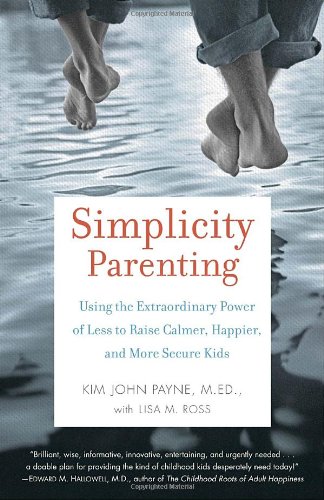
Greenreads: Simplicity Parenting

Do you ever feel kids have too much or are bombarded by too much? 
Media.
Toys.
Junk food.
Choices.
Games.
Books.
Real life adults lead.
Everything!


I love this book written by a Waldorf teacher (educational philosophy geared towards hands-on, natural, rhythmic, artistic, storytelling, simplicity, education, not standardized test-oriented education) and psychologist.

It tells of how children are getting so stressed out and overloaded by information and pleasures that they are in hyper-drive. So she urges parents to simplify their childrens' lives, routines, toys and information received. To in a sense protect our children from getting too much, too fast. "A protected childhood allows for the slow development of identity, well-being, and resiliency. Too much stuff leads to too little time and too little depth in the way kids see and explore their worlds."

She also mentioned every child has quirks, but that when they are stressed (sometimes in ways unbeknownst to us), those quirks turn into diagnosed behavioral problems. "Stress can push children along the behavioral spectrum. When you simplify a child's life on a number of levels, back they come. Behavioral tendencies can be soothed or relaxed by creating calm. We need to simplify in order to create and honor that "calm" for the sake of our children and their divine potential within them. We are here to nuture that potential and help them explore and exerience life in good and natural ways....not just to be entertained by toys, running around stressed from class-to-class, etc.

She walks you through step by step how to simplify in many areas and to create a stable environment in the home by creating daily pockets of predictability for your children and by having less clutter (books, toys, information, etc.). Here are some areas and suggestions (but read the book for more thorough advice and examples).


Toys
We have way too many toys for our children! They don't even play with half of them. "As you decrease the quantity of your child's toys and clutter, you increase their attention and their capacity for deep play."
Keep a few loved toys in clear sight and a few more organized in bins tucked away--reachable, but not always in sight. Get rid of all of the following toys:
1. Broken Toys
2. Developmentally Inappropriate Toys (pack away or donate those outgrown)
3. Conceptually "Fixed" Toys (simple toys allow imagination--not plastic unchangable outfits and TV heroes)
4. Toys That Do Too Much and Break Too Easily
5. High Stimulation Toys
6. Annoying or Offensive Toys
7. Toys that Claim to Give Your Child a Developmental Edge
8. Toys You Are Pressured to Buy
9. Toys that Inspire Corrosive Play (violence)
10. Toy Multiples

Expanding Play from Beyond Toys
Children need to experience (touch, see, feel, do, etc)...not just be entertained. Here are some thoughts for how children can play beyond toys:
Imaginary-Play
Purpose and Industry
Nature
Trial and Error
Social Interaction
Movement
Art & Music

Books
If you're like me you try to collect tons of used kids books. But the author says, "We honor the value of something (like reading) in our child's life by fostering a deep-not disposable--relationship to it." So if you have too much of anything, the child doesn't delve deeply into those things. Picking just one or two books before the child is eight is just fine, with 10 or so other books available as needed. Great books for children are fables and nursery ryhmes because they have rhythm and generally a problem/resolution and principle. Plus, most are based in nature and are very short and simple.
Here are some questions to ask, when thinking about your kids book collection:
Is it developmentally Appropriate?
Is the book based on a product of TV character?
Does it tell an unfolding story or is it "all over the place?"

Rhythm
Rhythm and predictability are what we aim for; predictabilty may be what we can acheive. This predictability help provide security for our children so they feel more happy and calm. She talks about the power of talking to your children more and creating predictability. How often do we run around "living" our lives, but not communicating clearly with our children about what we are doing or what to expect. If we treat them like kids and leave them in the dark. We need to provide pauses to help them know we're about to leave. We need to pick them up face to face and hand in hand, not grab them from behind (which makes them feel insecure and forced) and push them to our next event for the day. Do we help our children see who they are and how they are living and acheive meaning and purpose? Or do they let overwhleming toys, books and media tell them about what life "should" be like? I would suggest that if our children aren't happy, there are inner needs not being met. I always smile when my boy sings, because of the quote "A child who sings is a happy child." And when he seems unhappy and whiny...then I ask myself what I need to do to change my attitude (or stress-level) and how I can better focus on him and simplify.

"Rhythms establish a foundation of cooperation and connection. And relationships are often built in the intervals, the spaces between activities, when nothing much is going on." So don't be too busy.

Also I love the simple dinners built on consistent menus so that consistency is valued more than personal preferences and so that children can be involved to prepare it and clean up together.

Pressure valves: kids need to release steam and energy throughout the day. Ex: right after school and sitting so long...a quiet time might be needed. Or time before bed to slow down and unwind. Storytime is the best example of this and a great chance for parents to connect and help create a picture of the next day for their children. If children don't have these times they have a hard time sleeping at night. Look for opportunities to build a few into your days for your child's sanity.


----------
I stopped taking notes halfway through...so next time I read it I will finish. :)