Thursday, February 26, 2015

Power of an Hour

I've been enjoying what Donna Goff calls "Power of an Hour." This is one hour most days of the week which you spend with your family (specifically for homeschooling) in focused learning. She has a basic structure you can read about if you google her stuff, but I wanted to share how I'm implementing it in my family.

Each morning Monday-Friday we try to have a "Power Hour" together. If I do nothing else with my kids "academically" I'm set if I get this in.

We break the hour into about 15 minute segments but are very flexible according to child's interests and needs. And We normally call it blanket-time so the kids sit on their own blanket where they are to stay put; but we start it together doing a study, then alone for other parts of the hour, depending on the day and area or focus. So here's the basic outline:

TruthScripturedoctrine
GoodnessClassic/Character virtue
BeautyCreationsymbols
Express/Celebrate Selffree-play

And each day looka a little different, but progresses in nature and varies by topic:
Monday
Tuesday
Wednesday
Thursday
Friday
Foundation
Nature/Poetry
Music
Art
Celebrate
Experience
Instruct
Repeat/Practice
Review/Summarize
Live & Love it!
So here is a description of each segment

Truth: Build Foundation with Scripture -- Eternal Truths
For now, we just pick one scripture story/section a week. Ethan keep's track of his learning and the stories and principles in his homemade "Plates of Ethan" with blank pages to draw, write, glue pictures in, etc. This format is very flexible and lets me do whatever story I want however I feel inspired to at that moment.

We did Lehi's Tree of Life Vision last week, so here's what it looked like.
Monday: Experience the story
I told him the story (paraphrasing, while still using the scripture language/verses as best I could) and we found a picture from a magazine to cut out and put in his "Plates of Ethan" he made to record stuff he's learning. Then we act it out and share it again at Family Home Evening that night with Dad and pull out the main principle/phrase to remember (and learn a primary song that goes along with it).
Tuesday: Recall/Explore
We went over 2-3 vocab words and practiced a few simple sight words in the main verses. I asked what he remembered.
Wednesday: Repetition and Practice (diligence)
We went over vocab and sight words again.
Thursday: Review/Summarize
We went over everything again, but then he drew what he wanted to capture what he learned that week.
Friday: Celebrate
Play a game or act out something from the story so it is remembered as fun and the pieces stick!
I've found that Ethan soaks up things when they are fun and not pressured and he's practically memorized some of these vocab words and verses just by having fun discussing and pulling them apart. And it really is for only 10 minutes or so each day.


Goodness: Observe Greatness in Others' -- Noble Virtues
Character/Values: We will typically introduce a character value each week. For now we are focusing on Character either using stories from Janeen Brady's Character Series or from Stephen Covey's 7 Habits for Highly Effective Kids Series. As they get older we will actually study biographies of real noble men and women.
Classics (Books): We will also be focusing regularly on a classic novel, but instead of reading it during this morning time we want the character study in the morning and the Classic book at night (Dad can read at bedtime a few nights a week). (Barnes and Noble has sixteen of their classics illustrated and compiled in easy, condensed format for children and they are beautiful! This is a great introduction to the classics for young kids that aren't ready for the complete classic.).
Other Classics (music, art, etc.): During the week we will introduce classical music, art and poetry too by one particular artist, musician, etc. on the particular day for that topic (see chart below).


Beauty: Explore and Learn from Nature -- Natural Laws
Math & Science: Each week we focus on some aspect of math or science (currently is is a weekly shape focus). And I will provide tools, books,and  toys that relate to that theme. For example: we've been studying lines, so I got lots of line books from the library and gathered various line tools (Popsicle sticks,  pipe cleaners, paper strips, string, etc.) and we explore one or more each day to gain a deeper understanding of all the ways lines are used. I like to use things he's familiar with that surround us already, rather than go buy specific items--but it takes my mental energy to gather ideas and these tools.
Nature (also bodies): Then we celebrate and play and always try to get outside at least a few time a week, no matter the weather. Not always the funnest for mom, but I don't always have to go out. And Ethan never minds going outside, so I will capitalize on that! This also includes doing scavenger hunts and doing movement and yoga type activities with our bodies to explore how these principles are found all around us and as part of us.

Free-Play is tied into Beauty, but also is just letting Ethan explore everything he's just learned in his own ways once the "Power Hour" is over. He normally is good for an hour of free-play after this, which gives me a nice break. :)

------------------------


Chaos to Order: A Variety of Shelves and Spaces

I teach Ethan that home is special and where we want to be. And the same principle hold true for his stuff. Everything has a home and get's sad when it's not back in its home when all is said and done. But more than that, the "house elf" will take what's left out and he cannot be sure when or if the elf will ever give it back...so he has to be responsible with his things. (randomly the elf make return things for good behavior)

I wanted to write down some shelves and spaces I have and their functions, to give an idea of how this helps keeps us organized.


Ethan's Book Shelves

  • BedTime & Classics Books: bedtime books are specific stories I feel help remind Ethan he is loved or that provide security and calm before bed. We read these to him for now and there are about 6 of those. Plus we bought 16 kids classics from B&N that we will typically alternate with bedtime stories to do one a week or so, a few pages at a time (building his familiarity with Classics in a kid version).
  • Sunday & Character Books: about the Gospel or Max Lucado books (which I love), or character qualities (Franklin Covey 7 Habits for Kids stories series, etc.). We also read these to him and there are about 10-15.
  • Reading Time Books: this has about 10 books at a time that are simple for him to pick up reading on, should he choose, and we rotate through those as he gets bored, or as holidays/seasons change (or for age appropriateness). This helps him get familiar with certain books and words to build his sight-reading.
  • Other: we also have a sprinkling of language-learning type fun storybooks (Slangman are good) or Paul's childhood books that we like to throw in for variety that we keep up with the Sunday books so Ethan doesn't see them, but we can pull them out at random times. He loves the element of surprise (especially when the House Elf has brought him a different book)
  • Library Books: these always stay in the reading room up high so they don't get confused with his others or mangled by toddlers, but I try to limit it to 5 a week now, instead of 20. Which generally adds up to one new book each weekday during our noon storytime half-hour (which we read a new one, a familiar one and then
  • Special Shelf:  This one isn't specifically for books, persay; but it's for things that Ethan feels are special and includes two books that are actually "his" and not the "family library" like the rest of the books. The two books are You Are Special (board board version) and The Book of Mormon. 
Having these shelves keeps my organized and provides a good framework and provides variety and also surprise potential. It's also fun to have different areas. The formal books and reading time/library books are in our formal reading room. His bedtime books are by his bed, but up high.

Side note about treatment: I use to give my kids all the books they had, regardless of location and age. Now, I've come to the perspective that if they can't treat the book nicely, they can't have it. (or if it gets damaged it goes away for awhile and is taped/fixed quickly). This builds respect for books (and it's use as a tool and "friend") and responsibility for taking care of things (stewardship). (granted...it's still hard with my two year old and her ABC book, with no biting on it...so we aren't by any means perfect at this...but we try).


Ethan's Spaces
I think I'd go crazy if I lived in a one-room house with all the family and tried homeschooling (at least in Winter or if we couldn't get out much). So we've made different areas of interest for Ethan (and my sanity).
  • His Bedroom: has his special shelves right next to his bed for only his stuff (a few books a box of duplos and his lil' critters, and his special shelf)
  • His Closet (Book Nook): has his memory board to hang things he wants to look at or remember, his car mat/blanket thing and a bucket of cars, and his mini-wagon parks there.
  • The Reading Room: This is our classics room that has our nice books (Gospel shelf and Classics Shelf, etc.) a world Map, etc. It also has his learning shelves: one for reading time books/workbooks and his "project basket" (threading, paper stuff and "tools" we're focusing on that week). And the other for his learning tools (chalkboard box with crayons and such, abacus, letter and number magnets and puzzles and his backpack (holds his character book for the week, scriptures, his journals and basic coloring supplies)
  • Secret Garden/Fort: we have a special sheet I grew up with that looks like grass and butterflies, etc. So we use that to cover a fort, where'er it may be in the house. This is his "secret garden" (named after the book--kid version we read to him). So he loves setting up camp anywhere...which provides a good deal of variety in his quiet times that have to be somewhere quiet and isolated (this is helpful when I need the reading room, or his sister is sleeping in his room and I'm not sure where else to put him.) And he just hinks it's cool to be somewhere different and under a blanket.
  • Outside: His campus! Go explore...mommy needs a break.

Toy Shelves & Boxes (see post on simplifying toys)
  • Great Room/Main Space: there are a few boxes in the main area where the kids and I spend a majority of our time. They are actually different themes:
  1. Music & Movement Box: shakers, flutes, drum, scarves, etc.
  2. Story-Time Box: puppets and little critters to tell stories with (or for an easier version of hide and seek I don't have to find awkward spots to hide in or search all over the house for a real person)
  3. Building Blocks & also a Pattern Blocks Box: Endless creative building and helpful in conjunction with other toys
  4. Wood Train Box
  5. Nellie's Toddler Bin
  6. Ethan's Tool Box
  • Ethan's Room: 
  1. Dress up Box
  2. Closet Toys: a wagon and a box of cars
  3. Stuffed animals
  4. Sunday Box up on shelf (just pull down on sundays): sunday puzzles, books, Noah's ark toys, etc.
  • Reading Room (already explained some of this above)
  1. Project Basket (for threading or paper-folding things he's working on)
  2. Learning Tools (magnet letter and numbers, tangrams and various puzzles, cards, games, etc.)
  • Garage shelf: an easy place for him to park his bike/scooter and to put his bucket/wheel-barrow/shovels on the shelf above
  • Basement Box: hidden away are some other toys he likes or other-age-appropriate toys he doesn't need at that time that we rotate through (like rotating through books, it keeps the element of variety/surprise alive)

Other Shelves
  • 6 small Clothes drawers are low and in a logical order with a manageable amount of pieces(6 small drawers: pants, shorts, short-sleeve, long-sleeve, underwear, pj)
  • Shoe shelf in front closet so he know where his shoes "rest" for the night
  • Blanket and pillow shelf for his few extra blankets if he needs more fort material or if he peed the bed and needs to take care of it.

Examples of Good Books

I was typing this list in another post and it was getting too long, so I thought I'd start it here. But basically there are a lot of books in the world. Many of which are totally empty of value and character. I didn't realize how many garbage books there were that have no purpose except to take away your attention and time from other more awesome books you could've been reading. So...here are some good ones I like--definitely not comprehensive--just to whet the appetite. If you want more of my books I like and reviews...check out my Goodreads shelves...I've got a ton on there.

Wordless:
The Adventures of Polo (basically a wordless comic book)
Quest & Journey (adventures that left my son asking me to "read" it again)
The Snowman (a favorite from England)
Suzy Lee

Simple Illustrations
Not a Box
Rabbit/Duck (illustration looks like a rabbit, or a duck, depending how you see it)
Harold & the Purple Crayon
Potty

Interactive:
Press Here

Character:
Any Max Lucado: You Are Special, Just the Way You Are...etc.
Covey 7 Habits for Kids Series
A Fly Went By (being a problem solver)
Janeen Brady's Standing Tall Series (not all are amazing, but I love a few of them--on Youtube)
The Crayon Box That Talked
Did You Fill A Bucket Today?
The Giving Tree

Music & Movement (feel/experience while learning)
Zin Zin Zin! A Violin (poem with CD)
Peter & the Wolf (story with CD)
Do You Hear it? (with CD: listen to clip, look at art and move like you feel as a result)
Little Hands Fingerplay and Actions Songs
ABC Yoga

Art (empowering creativity)
Peter Reynolds: -Ish, The Dot, etc.
Look, Look, Look (how to analyze art...via a cute little mouse story)

Dr. Seuss (character and imagination)
Gerald McBoing Boing
Did I Ever Tell You How Lucky You Are
Trouble Getting to Solla Sollew
Horton: Hatches an Egg or Hears a Who
Grinch Who Stole Christmas
Yertle the Turtle and Other Stories
Thudwick the Big-hearted Moose
Hooray for Diffendoofer Day
Oh The Places You'll Go
...so many more!!!

Classics Introduction
Shakespeare's Seasons (quotes to memorize from his plays that follow the seasons)
B&N Illustrated Classics for Kids Series
Peter & the Wolf (with CD)


Fun with Shakespeare for Kids

How to Think Like Leonardo DaVinci

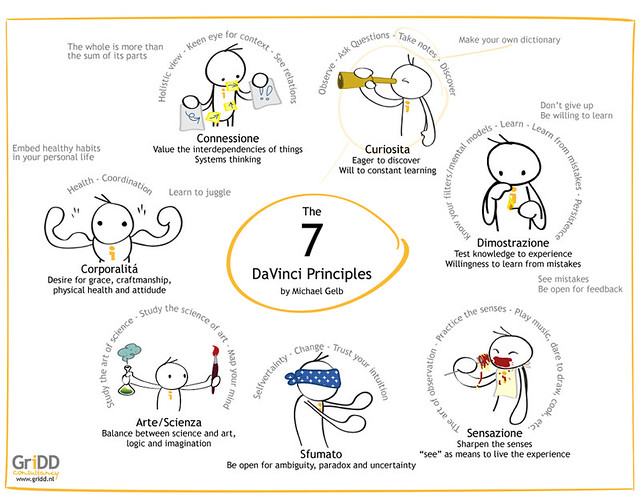
I have been glimpsing through this interesting book by Michael Gelb who studied Leonardo Davinci's writings and found 7 key principles behind what made Davinci the genius he was. Below is his list. 


Davinci's 7 Keys to Genius
  1. Curiosità: An insatiably curious approach to life and an unrelenting quest for continuous learning.
  2. Dimostrazione: A commitment to test knowledge through experience, persistence, and a willingness to learn from mistakes.
  3. Sensazione: The continual refinement of the senses, especially sight, as the means to enliven experience.
  4. Sfumato: A willingness to embrace ambiguity, paradox, and uncertainty.
  5. Arte/Scienza: The development of the balance between science and art, logic and imagination. “Whole-brain” thinking.
  6. Corporalitá: The cultivation of grace, ambidexterity, fitness, and poise.
  7. Connessione: A recognition of and appreciation for the interconnectedness of all things and phenomena. Systems thinking.

-------


*Which one of these seven habits can you work on this month???
Want to have ideas of how....try some of the self-assessments and activities from his book. The book has been outlined in an interactive online mind-map so you can find which you are interested in. Mind mapping is awesome! Click on the link above to try the mind map.

*Paul and I did the Curiosity 1st activity that is to jot down 100 questions that come to your mind as fast as you can. Then you go through them and find what common themes are. And narrow down your ten most important questions. IT was a fun activity.


------------
Here are the assessments from the book for each of the seven points.
Curiosita
ü  I keep a journal or notebook to record my insights and questions
ü  I take adequate time for contemplation and reflection
ü  I am always learning something new
ü  When I am faced with an important decision, I actively seek our different perspectives
ü  I am a voracious reader
ü  I learn from little children
ü  I am skilled at identifying and solving problems
ü  My friends would describe me as open-minded and curious
ü  When I hear or read a new word or phrase I look it up and make note of it
ü  I know a lot about other cultures and am always learning more
ü  I know or am involved in learning a language other than my native tongue
ü  I solicit feedback from my friends and relations and colleagues
ü  I love learning

Dimostrazione
ü  I am willing to acknowledge my mistakes
ü  My closest friends would agree that I am willing to acknowledge my mistakes
ü  I learn from my mistakes and rarely make the same one twice
ü  I question “conventional wisdom” and authority
ü  When a celebrity I admire endorses a product, I am more likely to buy it
ü  I can articulate my most fundamental beliefs and the reasons I hold them
ü  I have changed a deeply held belief because of practical experience
ü  I persevere in the face of obstacles
ü  I view adversity as an opportunity for growth
ü  I am sometimes susceptible to superstition
ü  In considering new ideas my friends say that I’m: a)gullible/”new-agey”, b) close-minded cynic, or c) open-minded skeptic

Sensazione
ü  I am sensitive to color harmonies and clashes
ü  I know the color of all my friends’ eyes
ü  I look out into the far horizon and up to the sky at least once a day
ü  I am good at describing a scene in detail
ü  I like doodling and drawing
ü  Friends would describe me as alert
ü  I am sensitive to subtle changes in lighting
ü  I can picture things clearly in my mind’s eye

Sfumato
ü  I am comfortable with ambiguity
ü  I am attuned to the rhythms of my intuition
ü  I thrive with change
ü  I see humor in everyday life
ü  I have a tendency to “jump to conclusions”
ü  I enjoy riddles, puzzles and puns
ü  I usually know when I’m feeling anxious
ü  I spend sufficient time on my own
ü  I trust my gut
ü  I can comfortably hold contradictory ideas in my mind
ü  I delight in paradox and am sensitive to irony
ü  I appreciate the importance of conflict in inspiring creativity

Arte/Scienza
ü  I like details
ü  I am almost always on time
ü  I am skilled at math
ü  I rely on logic
ü  I write clearly
ü  Friends describe me as very articulate
ü  Analysis is one of my strengths
ü  I am organized and disciplined
ü  I like lists
ü  I read a book starting at page one and go through in order

ü  I am highly imaginative
ü  I am good at brainstorming
ü  I often say or do the unexpected
ü  I love to doodle
ü  I am better at geometry than algebra
ü  I read a book by skipping around
ü  I prefer to look at the big picture ad leave details to someone else
ü  I often lose track of time
ü  I rely on intuition

Corporalita
ü  I am aerobically fit
ü  I am getting stronger
ü  My flexibility is improving
ü  I know when my body is tense or relaxed
ü  I am knowledgable about diet and nutrition
ü  Friends would describe me as graceful
ü  I am becoming more ambidextrous
ü  I am aware of the ways in which my physical astate affects my attitudes
ü  I have a good understanding of practical anatomy
ü  I am well coordinated
ü  I love to move

Connessione
ü  I am ecologically aware
ü  UI enjoy similies, analogies and metaphor
ü  I frequently make connections that others don’t see
ü  When I travel I am struck more by people’s similarities than their differences
ü  I seek a holistic approach to diet, health and healing
ü  I have a well-developed sense of proportion
ü  I can articulate the systems dynamics—the patterns, connections, and networks—in my family and workplace
ü  My life goals and priorities are formulated clearly and integrated with my values and sense of purpose
ü  I sometimes experience a sense of connectedness with all Creation


Distraction. A Good Thing?

Distraction. A Good thing?

For many of us that like to attempt multi-tasking everything and running around trying to do too much, distraction may not be a good thing. We need to prioritize and know what is most important so we can stay on track doing what matters most and not trying to keep up with everything someone else thinks we should be doing.

And yet, I stick with my title of this post. Why?

My husband actually mentioned this tonight while struggling to feed our kids. And I thought..."that's my next post." So let's look at "distraction" from another perspective....

  • Dilemna: My two-year old child is trying to climb up the hutch in the kitchen because she sees her big brother on top (put there by Dad for fun---that's another story). Little girl can't get up: throwing tantrum. (I'm thinking: "Not safe...no way are you getting up there girl! Not going to happen.)
  • Distraction: "Nellie want to wrestle/dance with Dad?" --Boom! and she's off to the living room, delighted with a new quest she can conquer!
  • Dilemna: My four year old will not eat his dinner and he's too tired to focus on eating (don't even get me started...bane of my existence!). (I'm thinking: "You will eat what I made you. Dang it. It's not moldy. Won't make you sick. So please...just eat it! Now.")
  • Distraction: "You're growing dragon scales! Woah!" Those peas must be making you turn into a dragon! Crazy!" *giggles from said four year old. Followed by serious pea-popping and more giggles. "Am I growing wings?"*

These are the moments we face daily: Struggles and discipline? Or trips of fantasy and adventure into a world of your/their own creation? Excitement, enthusiasm and joy fill their little minds....

So, I admit, I feel extremely left-brained at times; but I have to say that homeschooling is sure good at making me step out of my left-brained world and more fully accept a creative and fun approach to life and learning with my kids. I still yell and get annoyed more than I should at kids' imperfections, but I'm getting better at understanding their limits (mentally especially). Kids need things simple and direct, without baggage and blame. They need rules, but not guilt. They feel consequences...without too much explanation. We as moms are guides: placing good examples in their path and helping them see true principles and feel the beauty and meaning of them in their own time and way. The children will draw their own conclusions when they are ready.

So, one thing to help provide our kids with distractions is awareness: What does your child love? What do they need? How do they feel? Do they feel loved? (Are we paying attention to our kids on a deeper level? Are we holding them and telling them we love them? Do they feel they are special and know their real worth?)

Love and gratitude are the two most important things in the world (if you haven't heard of the rice experiement, try it out. Love and gratitude are powerful words/feelings). I view them as being first, that which is given/received; followed by second, the mirroring of that which was given/received. So combined, love and gratitude come full-circle into a complete fullness of feeling. If we are without one, most likely we aren't experiencing either to the full extent possible.

That said; one thing I detest is whining. Can't stand it. Will not tolerate it in my house. And Ethan knows it. Drives me up the wall! I'm serious. I don't know why my whine-tolerance levels are completely whack; but I hate, hate, hate whining with a passion (can you tell?).

So, Ethan knows that whining will not get him anything but an angry mom. And this angry mom yells when pushed to "strike three." (which I'm working on) He also knows that whining is not being grateful. And being grateful is a huge focus at our house! (I'm still meaning to make a wall-hanging on wood that says something about love and gratitude...but my crafty-intelligence hasn't completely caught up with that thought yet. Alas.)

I try to teach principles, and then discipline according to such rules; but sometimes kids just need distraction if they aren't "getting it." So when we come across whining in our day and principles/logic just aren't working, I will use distraction/creativity....
  • Dilemna: "I want juice!" (I'm thinking: "No you can't drink sugar junk all day, you already hyper monster!"
  • Distraction: "This magic bottle is a laughing potion. It starts with a smile and gets bigger and bigger until..." *then giggles start and we sit and eat lunch together talking about potions and Elsa in Frozen or something (everything goes back to that movie right now)."

So, why am I rambling about this? Well, it has been very handy for my own kids and also helped me be more patient with others' kids who may be low on the gratitude spectrum. And it's sure better for me too, when I'm trying to figure out how best to cope with annoying and imperfect little behaviors. Afterall, I am a mom of soon-to-be three. So I better learn coping mechanisms for my own sanity. And I think an adventure-beyond-reality is a good way to go for the kid in all of us. I need to laugh things off (like a pressure cooker with a release valve. Don't let it stick too tight--in reality and explanations--but let a little imagination keep the valve a-bouncin'. Then pressure and stress can dissipate).


(btw....I write all these posts because I need them for myself. So if anyone is getting value from them--fabulous!. If not...I don't really care, because they really are for me anyway. :) So don't judge me too harshly for them. They are mine. And I'm just a mom trying to get my thoughts and feelings out for my own sanity. And lucky you (or unlucky) are privy to the intricate workings of my mind.

The Power of Story

I read a few books and wanted to capture my notes...


-----------
In The Read-Aloud Handbook, by Jim Trelease, he mentions a formular to help children desire to read. By noticing a child's motivation behind reading and by limiting the difficulty of effort in doing so you can better encourage (maximize frequency) reading.


Reward
---------     =  Frequency
Effort


Reading Rewards

  • escape
  • information
  • prestige or honors (grades, etc.)


Reading Effort (hindrances)

  • distractions
  • lack of time
  • availability
  • disability
  • negative perceptions
We can't get better at reading if we aren't listening well. And we won't write well if we aren't speaking or reading well. It is a process. I like thinking in terms of this process and the following chart to better understand...
  1. Listen
  2. Speak
  3. Read
  4. Write

Understanding this should clarify our need for us not to rush our kids into writing. Little kids are still learning language and how to listen and speak. They shouldn't need to master writing until they are more comfortable with the first parts in this process. When that happens the other later pieces will more naturally occur and most likely even faster.


Cursive vs Print

There is debate about print vs. cursive. But my thought is that the debate will never win one side or the other. Why? Because, as with all things, it depends what the purpose is?

  • Are we teaching writing just to get our kids able to communicate with the world via papers and books?
  • Are we trying not to lose a "dying tradition"? (which is really an art)
  • Are we wanting to make our two year olds academically competent?

Either route we go, I don't think writing should be forced. When kids feel stressed, their brain can't store memory long-term. That is why games and fun avenues for approaching learning (like stories and songs) are best for children.

I also feel that writing shouldn't be pushed too early. Cursive probably requires more hand control and shouldn't be approached too early. What are the building blocks of writing? lines and curves. In waldorf they first focus on drawing vertical and horizontal lines. They practice all sorts of designs they can make and patterns...with just simple lines. Then they move on to adding a curve, like a "c". They make lots of types of desins with curves. Then they combine the two into simple drawings and patterns, almost mimicing letters....without ever saying they are. And before you know it, the kids are ready to put them together into actually letters, confident they can creat. Otherwise kids just see random messes of lines and writing doesn't make sense. So first, give the line and curve experience to your children. Build their "drawing confidence." Let's not push handwriting before we've helped our kids gain experience and love for art along those "lines?" hehe.


That said. You can't gracefully pull off something you haven't mastered. Print, to me, is writing without that grace. Is that bad? No, but it misses something that could be that much more. Like basic writing, vs. poetry.

Is poetry all that we should read? no. But the rhythm and beauty of the words are felt and have a more multi-sensory approach. It's effect on the brain is more whole in that it helps cross and use both left and right brain hemispheres together. This helps learning stick and is healthier cognitively. It is the same with cursive. 

If you feel "off" (like too analytical or too right-brained), then reading a little poetry (or cross-crawling if you're into Donna Eden's energy work stuff or brain gym for us all, but especially those with special needs) helps reset the brain. You can read other articles about brain specifics if interested.

I love in Waldorf how they first introduce letters via a picture that has the letter shape in it as an organic part of the picture. And they normally do it through a story. So the child can connect a visual and remember in a whole-brain way.

So, in order to personally answer this question I think it important to know your purpose for teaching writing. Then take that into account with the ages of your children and their needs. How can you teach and learn writing in a fun way without stress?